Chapter Five
Those Who Came Down
Back to the days of Jared
To tell this part properly, we have to go back a little way: back past Noah's birth, to the days of Jared.
By then it had been hundreds of years since the garden, and the children of Adam had spread out over the earth like water poured on a floor. There were towns now, and fields, and roads between them. There was music in the evenings and hammering in the forges, goods to be weighed and land to be claimed. And there were daughters, born in every house, and they grew up beautiful.
The Watchers saw them.
Chapter Five
Those Who Came Down
The oath on Hermon
You will remember who the Watchers were. They were among the singers who had sung on the first night of the world, and in the days of Jared, God had sent a company of them down to the earth to watch over the children of Adam: to teach them, and guard them, and help them do what was right. They were very bright and very strong and very old, and for a long time they did exactly as they were told.
But they had been watching for a long time. And one evening, looking down at a village by a river, where the young women had come out to draw water in the last of the light, one of them said what several of them had been thinking.
"Look at them."
And the others looked.
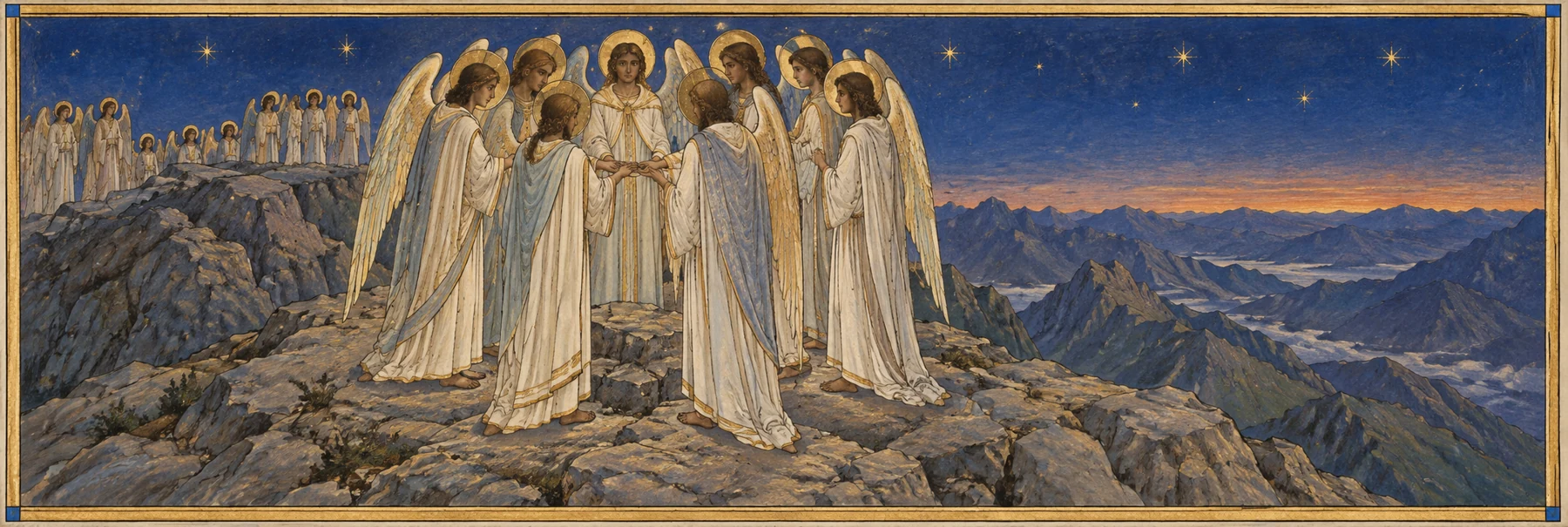
Their captain was named Semjaza, and it was he who called them together, two hundred of them, on the summit of Mount Hermon. It was night. The stars were very close. Somewhere far down the mountain a dog barked in a village, and stopped.
Chapter Five
Those Who Came Down
The oath on Hermon
"Come," they said to one another. "Let us choose wives from among the daughters of men, and have children of our own."
And then Semjaza said a strange thing, which shows that he knew perfectly well what they were doing. "I am afraid," he said, "that you will not really go through with this. And then I alone will have to pay the penalty for a great sin."
So they swore. All two hundred of them, there on the mountaintop, bound themselves to one another with an oath and a curse: that not one of them would turn back. And because of what they swore there, the mountain has carried the name of that oath ever since.
Then they came down.
Chapter Five
Those Who Came Down
The forbidden arts
They came down into the villages and towns, and each of them chose a wife, whichever woman he wanted. The guardians went into the homes of the very people they had been sent to guard.
And they began to teach, as they had been sent to teach. But not what they had been sent to teach.
One of them, whose name was Azazel, built a forge. He showed the men how to dig the bright metals out of the hills and work them, and then he showed them what to make. He showed them how to make swords. And knives. And shields, and breastplates. Men had made tools before. They had never made anything whose whole purpose was to kill another man.
And for the women, Azazel made other things: bracelets, and ornaments, and costly stones cut to catch the light; little pots of black paint for the eyelids, and dyes of every colour. There was brightness for the body and armour to cover it, beauty to be wanted and weapons to take it with.
Chapter Five
Those Who Came Down
The forbidden arts
The others taught other things. Some taught spells and charms. Some taught the cutting of roots, for medicines and for worse than medicines. Some taught the reading of the stars, not to know when to sow, but to tell fortunes; and the signs of the clouds, and of the sun, and of the moon in its courses. Secrets that had been kept in heaven since the beginning of the world, they handed out on earth like sweets.
Chapter Five
Those Who Came Down
The hungry giants
Then the children came.
The women who had married the Watchers bore sons, and the sons were not like other children. They grew, and grew, and kept on growing, until they stood higher than the walls of their mothers' towns, and the ground shook when they walked. They were the Nephilim, the giants: the mighty men of old, men of renown. People told stories about them for thousands of years afterwards, in every country of the world, and got most of the stories wrong.
What the stories tend to leave out is that they were always hungry.
At first the giants ate what people gave them, and the harvest of a whole valley might go to feed one of them for a season. Then the harvests ran out, and people could not grow enough, and the giants began to take. They ate the cattle out of the fields. They ate the birds out of the air and the fish out of the rivers. And when there was nothing else, they turned on the people who had fed them, and ate them too.
Chapter Five
Those Who Came Down
The hungry giants
And then they turned on one another.
Blood ran in the streets of the towns and over the stones of the threshing floors. Men killed giants when they could, and giants killed men, and men, who had learned from Azazel how to make swords, killed other men for gold, or for land, or for nothing at all. The earth was filled with violence from one end to the other, and every thought that came into a man's heart was evil, all day long, every day.
And the earth itself cried out.
Chapter Five
Those Who Came Down
The cry of the earth
Far above, four of the greatest of God's servants heard it.
Their names were Michael, and Uriel, and Raphael, and Gabriel. They had not gone down with the Watchers; they had stayed where they belonged. And now they looked down from heaven and saw the earth, and the blood running on it, and they heard the cry going up from it, from the dying and from the souls of the dead, rising and rising until it beat against the very gates of heaven and would not stop.
So they went in together before God, and said:
Chapter Five
Those Who Came Down
The cry of the earth
"Lord of lords, God of gods, King of kings! You made all things, and You see all things, and nothing can hide from You. You see what Azazel has done: how he has taught all wickedness on the earth, and given away the secrets that were kept in heaven. You see Semjaza, and those he leads. They have gone to the daughters of men and defiled themselves, and the women have borne giants, and the whole earth is full of blood. The souls of the dead are crying at the gates, and their crying will not stop. You know all this. You see it. And You have not told us what to do."
And God was silent for a long moment. And then He did something you might not expect God to do.
He grieved.
Chapter Five
Those Who Came Down
The cry of the earth
He looked at the earth He had made, the earth He had stepped back from on the sixth day and called very good. He looked at the creature He had shaped out of red clay with His own hands and breathed into with His own breath. And He was sorry He had ever made him. It hurt Him, in His heart. If you have ever made something with great love and watched it spoil, you know a very little of what He felt.
"I will blot them out," He said. "Man, whom I created, from the face of the earth: man, and beast, and the creeping things, and the birds of the air. I am sorry that I made them."
But then He said: "My Spirit will not strive with man forever. He shall have a hundred and twenty years."
A hundred and twenty years. It was the last mercy. Time enough for anyone who would listen to turn round.
Chapter Five
Those Who Came Down
One man walking the other way
Because there was one man God was not sorry about.
Noah found favour in the eyes of the LORD.
The shining baby had grown into a quiet, strong, weathered man, a farmer, and he did the thing his great-grandfather Enoch had done, the thing hardly anyone in the world did any more. He walked with God. He was righteous, and blameless, in the middle of a generation that was neither.
The long lives around him were ending. Seth had gone, at nine hundred and twelve, and then Enosh, and Kenan, and Mahalalel, and Jared, each laid in the ground beside his fathers. Methuselah was still there, very old now, older than anyone had ever been. Noah had married a woman named Emzara, and when he was five hundred years old they began to have sons: Shem, and Ham, and Japheth. In time the boys grew up and took wives of their own.
Chapter Five
Those Who Came Down
One man walking the other way
Walking with God was not easy for Noah. Everyone around him had been to the forges, and wore the gold, and read the stars for omens. Noah did not. Everyone around him carried a sword. Noah did not. In all that great noisy crowd going one way, there was one man going the other, and people noticed, and they did not like it. He found favour in the eyes of the LORD. He did not find it in the eyes of his neighbours.
And Noah did not keep quiet. That was what made them angry. He went into the markets and told them to stop. He told them God saw what they were doing. He told them to put down their swords and turn back to the God their fathers had called on in the days of Enosh, before it was too late.
Chapter Five
Those Who Came Down
One man walking the other way
They laughed at him. Then they stopped laughing and started watching him, the way you watch a man you are thinking of hurting. And Noah, who was brave but not foolish, saw that they meant to kill him, and his wife and his sons and his sons' wives along with him. So he took his family and everything they had, and went away out of that country.
He could leave the place. He could not leave behind what was coming.
That was where the angel found him.
It was Uriel. He came the way angels come, all at once, standing where there had been no one standing, so bright that Noah's shadow was thrown out long behind him across the ground. And the first thing he said was not a greeting.
"Hide yourself!"
Then he told Noah everything: that the end was coming, that a flood would cover the whole earth and destroy everything on it. "But not you," said the angel. "You will be shown how to escape, and your children after you. Through you the world will go on."
Chapter Five
Those Who Came Down
The binding
Elsewhere, at the same time, the other three were about their work.
Raphael went down into a desert, a dry and broken place called Dudael, and found Azazel there. And Azazel, who had taught the world to make swords, found that none of them were any use to him now. Raphael bound him hand and foot, and opened a pit in the desert, and threw him into it. He piled rough, jagged rocks on top of him, and covered him with darkness, and covered his face so that he would never see light again. And there Azazel lies, and must lie, until the great day of judgment.
Gabriel went to the giants. He did not fight them. He did not need to. He set them against one another, and the giants, who had never been anything but hungry and angry, turned on each other with Azazel's swords in their enormous hands, and fell, one after another, across the valleys, until none were left standing.
Chapter Five
Those Who Came Down
The binding
And Michael went to Semjaza and the two hundred who had sworn on Hermon. He made them watch. He made them stand and see their sons destroy each other, every one, and the long lives they had hoped for their children come to nothing. And when it was over, he bound them too, and took them down into the deep places under the hills, into the dark valleys of the earth, and left them there in chains to wait for the judgment.
They had come down because they wanted to belong to the earth. Now they would be kept in it.
Chapter Five
Those Who Came Down
A promise and a wooden chest
And God said to Noah:
"Make yourself an ark."
It was not a ship that God described. It had no sail, and no oars, and no rudder; it would not need to go anywhere. It was a box: an enormous, floating wooden chest, made to keep what was inside it safe.
"Make it of gopher wood," God said. "Make rooms in it, and cover it with pitch, inside and out. Make it three hundred cubits long, fifty cubits wide, and thirty cubits high. Make an opening for light at the top, a cubit below the roof. Put a door in the side. Give it three decks: a lower, a middle, and an upper.
"I am going to bring a flood of water on the earth, to destroy everything under heaven that has the breath of life in it. Everything on the earth will die.
"But with you I will make a covenant."
Chapter Five
Those Who Came Down
A promise and a wooden chest
It was the first time that word was ever spoken in the world: covenant, a binding promise. God made it with one man, right in the middle of telling him about the end of everything.
"You will go into the ark, you and your sons, and your wife, and your sons' wives with you. And of every living thing you will bring a male and a female into the ark, to keep them alive with you: birds after their kind, cattle after their kind, every creeping thing after its kind. They will come to you. And take every kind of food that is eaten, and store it up, for you and for them."
Noah listened to all of it. He did not argue. He did not ask how a man his age, with only three sons to help him, was going to build a box three hundred cubits long, or what the neighbours would say.
He went and found the trees, and began.
Chapter Five
Those Who Came Down
The years of building
It took years. It took more years than you would believe. Every tree had to be felled by hand and dragged and split and shaped. Every plank had to be fitted to the next. Every seam, inside and out, had to be sealed with hot black pitch, so that when the time came not one drop of water would get in.
Shem and Ham and Japheth worked beside their father all through those years. Their hands grew hard. And in the evenings, when the light went, the whole family sat together beside the great half-finished ribs of the thing, black against the sky, and listened to the frogs.
People came to look, of course. You could not hide a thing that size. They walked round it on summer evenings and laughed and asked the old man what it was for.
And Noah always told them.
Chapter Five
Those Who Came Down
The years of building
Then they went home, and ate their suppers, and drank their wine. They married, and gave their daughters in marriage, and planted their fields. Nothing changed. Nothing ever seemed to change. The sun came up, and the sun went down, and the sky was as blue as it had always been.
And on the hillside, through all those years, the box grew.
In the end, Noah did everything God had commanded him. Every cubit, every deck, every seam of pitch, every plank of gopher wood. He did all of it.
And then he waited for God to tell him it was time to go in.