The epilogue
After the Waters
The fruit of the vine
Every year after that, as long as Noah lived, he and his sons kept a feast to remember the covenant.
And the seasons came back, just as God had promised: seedtime and harvest, cold and heat, summer and winter. There was work to be done on the earth again. And Noah, who had been a man of the soil all his life, went back to it.
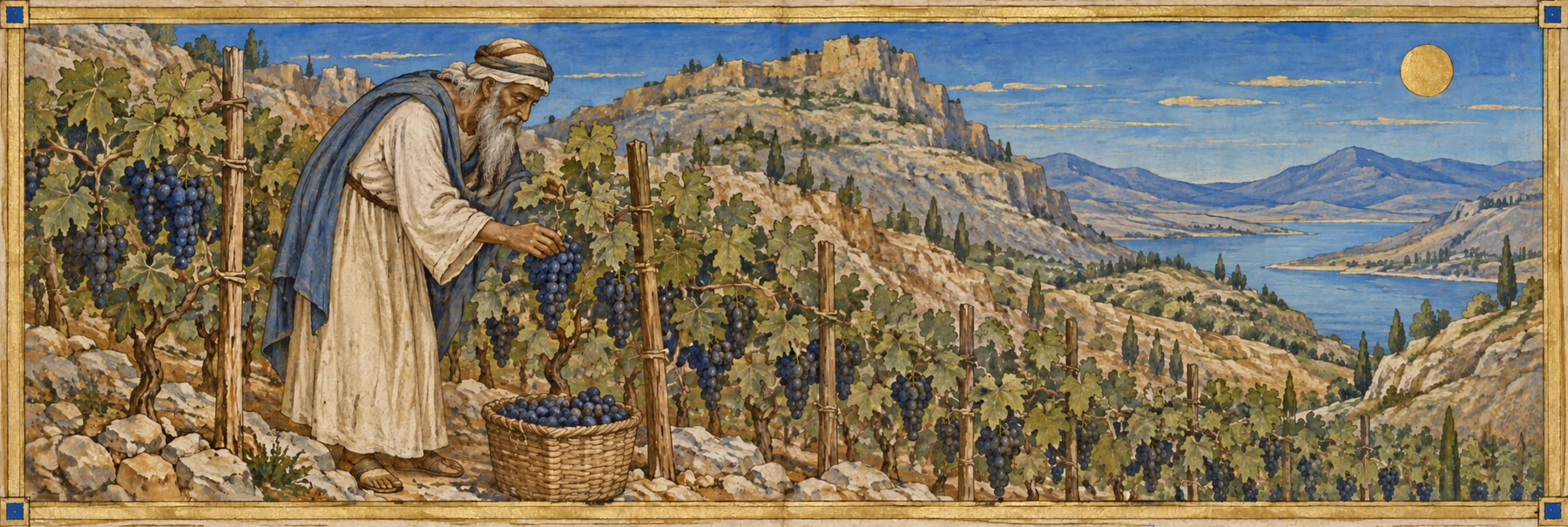
He planted a vineyard. He planted it on the slopes of Lubar, the mountain where the ark had come to rest, and tended the young vines, and waited. It was a long wait. A vine does not give its fruit in its first year, or its second, or its third. In the fourth year the grapes came at last, and he gathered them in the seventh month, and pressed them, and put the wine away in a jar. And he kept it until the first day of the first month of the next year.
The epilogue
After the Waters
The fruit of the vine
Then he made a feast. He offered a sacrifice to God, a young ox and a ram and seven lambs and a young goat, and sprinkled wine on the fire, and the sweet smoke went up. And afterwards Noah sat down with his children and his grandchildren round him, and they were glad together, and drank the new wine.
It had been a very long time since Noah had drunk any wine, and he did not know, as no one yet knew, how strong new wine could be, or that it ought to be mixed with water first. He drank, and he was glad, and he drank again. And when the evening came he went into his tent, and lay down, and fell into a heavy sleep. And in his sleep he threw off his covering, and lay there uncovered in the middle of the tent.
The epilogue
After the Waters
The covering
Ham, his youngest son, saw him.
He saw his father lying there drunk and naked, and he did not cover him. He went straight back out of the tent to where his brothers were, and told them.
Shem and Japheth did not laugh.
They took a cloak and held it up between them, and laid it across their shoulders. And they walked backwards into the tent: slowly, a step at a time, feeling their way with their heels, their faces turned away towards the door so that they would not see their father. And when they reached him they let the cloak fall over him, and covered him, and never once looked.
There are two ways of seeing a man's shame. One goes out and tells. The other walks backwards and covers it.
The epilogue
After the Waters
The names of the sons
When Noah woke, he knew what his youngest son had done to him.
And he spoke. His words came out like a prophecy, the way the words of very old men sometimes do, as if they were not altogether his own.
"Cursed be Canaan," he said. Canaan was Ham's own son. "A servant of servants shall he be to his brothers."
Ham heard it. He heard his father curse his child, and it struck him harder than if the curse had fallen on himself. For a father, the hurt of his child is worse than his own.
Then Noah turned to his eldest.
"Blessed be the LORD," he said, "the God of Shem! And let Canaan be his servant."
Shem's name means Name. And Noah did not bless Shem himself. He blessed Shem's God, the God whose name the children of Seth had called on ever since the days of Enosh. Shem would be the one who kept that Name.
The epilogue
After the Waters
The names of the sons
And then to Japheth, whose name sounds like wide: "May God make room for Japheth. May God make him wide. Let him live in the tents of Shem, and let Canaan be his servant."
The epilogue
After the Waters
Three cities
After that, the family began to come apart.
Ham was angry that his father had cursed his son. He went away, he and his sons, Cush and Mizraim and Put and Canaan, and built himself a city on the south side of the mountain, and named it after his wife.
Japheth saw it, and was jealous of his brother, and went and built a city of his own on the west side, and named it after his own wife.
Only Shem stayed. He built his city close by, on the east side of the mountain, facing it, and named it after his wife. And he looked after the old man.
So the three sons of Noah, a few years after coming out of the one ark together, were living in three cities; and one of them was angry, and one of them was jealous.
Noah called his grandsons together, and he taught them.
The epilogue
After the Waters
Three cities
"Do what is right," he told them. "Cover your shame. Bless the God who made you. Honour your father and your mother. Love your neighbour. Keep yourselves clean." And he told them why the flood had come: about the Watchers who had come down, and the giants, and the blood that had been shed on the earth until the earth itself cried out. He had lived through the end of that world. Now he could see its beginnings again, in the way his children were treating one another.
"I can see it already," he said. "You are not walking straight. You are pulling apart from each other, and envying each other, and you are not at peace, my sons, brother with brother. I am afraid that after I am dead you will shed men's blood on the earth again, and then you too will be wiped off the face of it.
"Do what is right. Plant yourselves in righteousness, over the whole face of the earth."
The epilogue
After the Waters
The book of remedies
And there was one more danger left over from the old world.
The giants had perished. But their spirits had not. They were still loose upon the earth, and they were hungry still, and now they came to the children of Noah's sons and began to lead them astray. They blinded them and deceived them, and some of them they killed.
Noah's sons came to him, frightened. And Noah prayed.
"God of the spirits of all flesh," he said, "You have been merciful to me. You saved me and my sons from the waters of the flood. Let Your mercy rest on my sons' children too. Do not let evil spirits rule over them and destroy them from the earth. You know what Your Watchers did in my days. These are their children. Shut them up. Hold them fast in the place of judgment. Do not let them destroy the children of Your servant."
And God told His angels to bind them all.
The epilogue
After the Waters
The book of remedies
But then the chief of those spirits came before God. His name was Mastema. "Lord, Creator," he said, "leave some of them to me. Let them listen to me and do as I say. If none are left to me, I cannot do my work among the sons of men, for the wickedness of the sons of men is great."
And God allowed it. One in ten was left upon the earth. The other nine were bound and taken down into the place of judgment.
But God did not leave Noah without help. An angel came and taught him about the sicknesses the spirits bring, and how to heal them with the herbs and plants of the earth. And Noah wrote it all down in a book, every remedy he was taught, and gave the book to Shem, his eldest son, because he loved him more than all the rest.
The epilogue
After the Waters
Down to the valleys
As the generations grew, the sons of Noah led their people down from the heights into the plains.
The others hung back. They were afraid of the low ground. They remembered the water. They stayed up on the hills while Noah's sons went down first, and settled, and showed them that the valleys were safe to live in. And slowly the others followed. There were flocks in the valleys again, and families on the land, and smoke going up from cooking fires in the evenings, and children being put to bed.
The epilogue
After the Waters
Another beginning
Noah lived three hundred and fifty years after the flood. There was trouble in those years, and worry for his children. But there was also the long life God gave him, and the earth giving its harvest, and every year the feast that remembered the promise.
At nine hundred and fifty, he died. They buried him on Mount Lubar, where the ark had come to rest. Of all the men who had lived on the earth, no one was more righteous than Noah, except for Enoch alone.
Two years after he was laid in the ground, by the reckoning this story follows, a baby was born in the land of the Chaldeans, and his name was Abram.
But that is another story.
The epilogue
After the Waters
And Someone remembered
The clouds still gathered over the hills and the plains. Rain still fell on the houses and the fields. And every now and then, through the rain, the bow appeared.
The people underneath it were the children of the people who had stood beneath the first one. They worked the ground, and kept their flocks, and held their children close. They had inherited the world, and the promise that had been made over it.
And Someone was looking at the bow, and remembering.