Chapter Three
Brothers
The first children
Outside the garden, the man dug, and the woman waited, and in time she had a child.
It was the first birth in the world. Nobody could tell her what it would be like, because nobody had ever done it before. All she had to go on was what God had said: that it would hurt. And it did. But at the end of it there was a boy, red-faced and furious and alive, and she held him up and laughed through her tears and said, "I have gotten a man, with the help of the LORD!"
So they called him Cain, which sounds like gotten. She had lost a garden. Now she had a son, and she meant to keep him.
Not long after, she had another boy, and they called him Abel. His name is harder to put into English. It means something like a breath on a cold morning: there, and then gone. Nobody knew yet how well it would fit him.
Chapter Three
Brothers
The first children
There were daughters too. The first was Awan, born a few years after Abel, and more came after her, sons and daughters both, until the family outside the gate was a family indeed.
Chapter Three
Brothers
Two gifts
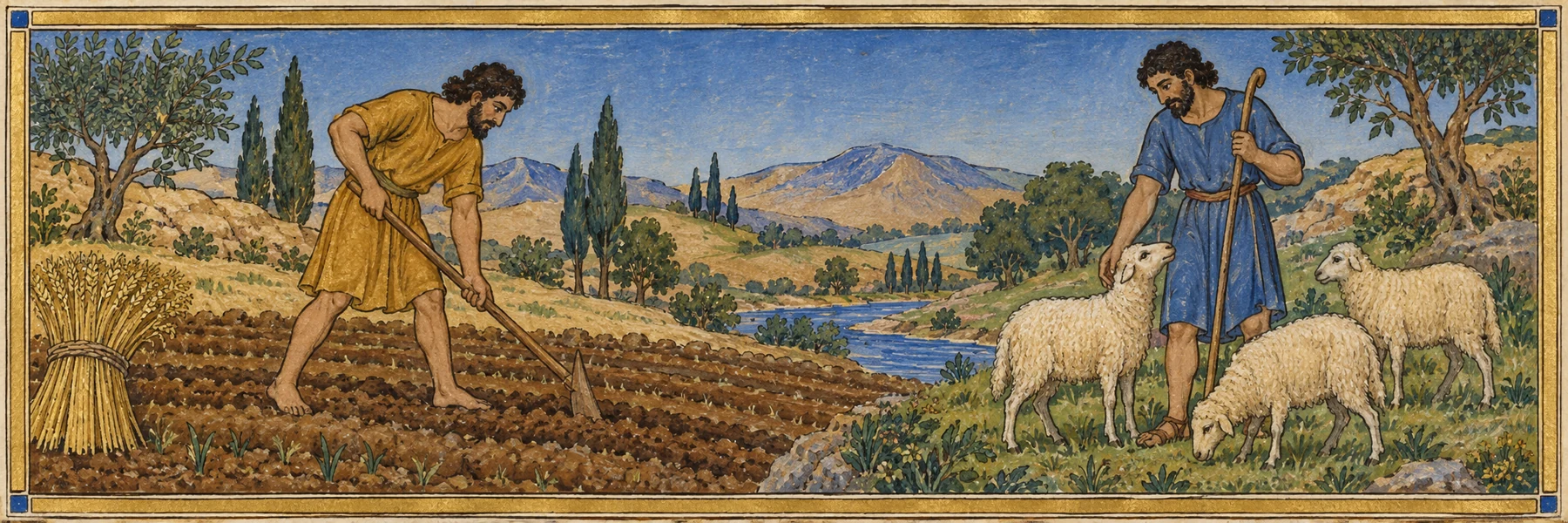
The boys grew up, and they chose different work.
Cain took after his father. He went out into the fields and broke the hard ground and sowed it, and he was the first man ever to drive a plough. It was the work his father had been given outside the garden, and Cain was good at it: clever, strong, tireless, and always thinking about what the ground might get him. He liked to have things.
Abel became a shepherd. He took the sheep up into the hills and found them grass and water, and carried the lambs home when they were tired. He was a gentle young man, and he lived as though God were watching him in everything he did, which God was.
And one day, when the harvest was in and the lambs had been born, the two brothers each brought God a gift.
Cain gathered some of what he had grown, and brought that. Not the first of it, and not the best. Some.
Chapter Three
Brothers
Two gifts
Abel chose the very first lambs his flock had borne that year, the best and fattest of them, and brought those.
And God looked with favour on Abel, and on Abel's gift. But on Cain, and on Cain's gift, He did not look in the same way.
Cain saw it. His face went dark, and he turned away and burned.
Chapter Three
Brothers
At the door
God came to him.
He did not have to. Nothing had happened yet. Abel was still alive, up in the hills with his sheep. But God came to Cain the way He used to come walking in the garden, and spoke to him.
"Why are you angry?" said God. "Why has your face fallen? If you do what is right, won't you be welcomed? But if you don't, sin is crouching at your door. It wants you, Cain. But you must master it."
Crouching at the door, like something waiting in the dark outside a tent: close enough to come in, but not in yet. The door was still Cain's to keep. He could still do what was right. His brother's welcome had not shut the way to his own. The whole of the rest of the story could have gone differently, right there.
Cain heard Him. You may be sure he heard every word.
And afterwards he went to his brother and said, "Come out with me to the field."
Chapter Three
Brothers
At the door
So they went out together, across the stubble, away from the houses and the flocks, out to where nobody could see.
And there in the field, Cain rose up against his brother Abel, and struck him with a stone, and killed him.
Then he looked round, and hid his brother's body where no one would find it, and walked home.
The first person who ever died in the world did not die of old age, or sickness, or an accident. He was killed by his brother, over God.
Chapter Three
Brothers
Where is your brother?
Some days went by.
Then God came to Cain again.
"Where is your brother Abel?" God asked. "I haven't seen him for many days. I used to see the two of you together."
And Cain said, "I don't know." And then, because the lie did not seem enough by itself, he added, with a sneer in it: "Am I my brother's keeper?"
His father had been put in a garden to keep it. His brother had kept sheep. And Cain stood in front of God and asked whether anyone had been given to him to keep.
"What have you done?" said God. And then, very quietly: "I am astonished at you, that you do not know what has become of the man you killed yourself.
"Listen. Your brother's blood is crying out to Me from the ground."
Chapter Three
Brothers
Where is your brother?
The body was hidden. The blood was not silent. Cain had worked that ground all his life. He knew how to open it for seed and wait for what came up. Now it had opened its mouth and taken something else from his hand, and what came up out of it was a cry. It had been crying all those days. Cain had not heard it. God had.
"Now you are cursed from the very ground that drank your brother's blood," said God. "When you work it, it will no longer give you its strength. You will be a wanderer and a fugitive on the earth."
And Cain, at last, was afraid.
"It's too much," he said. "My punishment is more than I can bear. You are driving me off the face of the earth, and away from Your face, and I'll be a wanderer and a fugitive, and whoever finds me will kill me."
There were people about by then, a good many of them: brothers and sisters, nephews and nieces, cousins in the next valley. Any one of them might have loved Abel.
Chapter Three
Brothers
Where is your brother?
"No," said God. "If anyone kills Cain, it will be avenged seven times over."
And God put a mark on Cain, so that whoever found him would know not to touch him. What it looked like, nobody has ever been able to say. What it was for, everybody knows.
So Cain went out from the presence of the LORD. His own family would no longer have him. He took his sister Awan as his wife, and went east, further east than his father had ever gone, into a country called Nod, which means Wandering. And he wandered there, in fear and trembling, for a long time.
Chapter Three
Brothers
The first city
But not forever. The strangest thing about Cain is what he did next.
The man God had sentenced to wander stopped wandering, and built a city.
He did not take his sentence as a reason to change. He took it as a reason to get even. He gathered other men about him, the restless and the greedy, and grew rich on raiding and violence, and taught them that whatever you can take is yours. And he changed the way people lived.
Before Cain, nobody had ever drawn a line on the ground and said this is mine and that is yours. Cain did. He set boundaries around the land. He invented weights and measures, so that everything could be counted and nothing given away. And he built a wall around the place where he lived, the first wall in the world, and made his people come inside it.
He called the city Enoch, after his eldest son.
Chapter Three
Brothers
The harp and the blade
Inside the walls, Cain's family grew. Enoch had a son named Irad, and Irad had Mehujael, and Mehujael had Methushael, and Methushael had a son named Lamech. And Lamech was the first man ever to take two wives. Their names were Adah and Zillah.
It was in Lamech's household that the arts were born.
Adah had a son named Jabal, and he was the first to live in tents and follow the herds from pasture to pasture. Her other son was Jubal, and he was the first who ever made music: the harp, and the pipe. After Jubal, the evenings in Cain's city were never quiet again.
Zillah had a son named Tubal-cain, stronger than any man alive, and he was the first to work metal, bronze and iron, hammered and shaped in the fire. And Zillah had a daughter, too, named Naamah.
So in a single household you had the tent and the herd, the harp and the pipe, the anvil and the blade. There was real skill in Cain's children, and real beauty in the things their hands could make.
Chapter Three
Brothers
The harp and the blade
And then there was Lamech's song.
It was a short one. He made his two wives sit and listen to it.
"Adah and Zillah, listen to me! Wives of Lamech, hear what I say! I have killed a man for wounding me, a young man for striking me. If Cain is avenged seven times, then Lamech seventy-seven times!"
Cain had been afraid that someone would kill him. His great-great-great-grandson stood in his house and made a song out of killing, and took God's protection of Cain as the measure of his own revenge. And every generation in that line, it is said, was worse than the one before: bold in war, eager for plunder, quick with a blade.
Chapter Three
Brothers
A child in the empty place
But that is not where the story of the brothers ends. It ends with a cradle.
Back in the land outside the garden, Adam and Eve mourned for Abel. They mourned for twenty-eight years.
And then, at last, they were glad again. Eve had another son, and when she held him, she said, "God has given me another child in place of Abel, because Cain killed him."
They called him Seth, a name that means set or appointed: a child set down in the place that had been left empty.
Seth grew up and married his sister Azura, and they had a son, and called him Enosh, which means a mortal man, a man who knows he will die. Adam and Eve had more children after Seth, many more, and the family went on growing.
And in the days of Enosh, something began that had not been done before. People began to gather together and call on God by His name.
Out east, behind Cain's walls, they were counting and claiming and forging blades and boasting to their wives.
Chapter Three
Brothers
A child in the empty place
And in the land outside the garden, they were calling on the name of the LORD.
Both were children of the man who had left the garden. Both lived on the ground he had been sent out to work. But they were already walking two very different roads.