Chapter Four
Nine Hundred Years
The memory of the garden
In those days, people lived a very long time.
Adam lived to be nine hundred and thirty. Seth lived to nine hundred and twelve. Their children and their children's children lived nearly as long, eight hundred years, nine hundred years, one after another, so that a man might know his own great-great-great-great-grandson, and bounce him on his knee, and tell him stories.
And Adam could.
That is the thing to remember about the first world. The story of the garden did not have to be handed down through a hundred mouths, getting smaller and stranger each time, like a stone worn smooth in a river. The man who had been made from the red earth was still there. He had seen God's face bent over him as he took his first breath. He had named the lion and the eagle. He had eaten the fruit. And for hundreds and hundreds of years he was still there. You can picture him, white-haired and slow, sitting outside his door in the evenings, with the children of his children's children gathered round to hear about the garden.
Chapter Four
Nine Hundred Years
The memory of the garden
He lived to see eight generations of his children born: Seth, and Seth's son Enosh; Enosh's son Kenan; Kenan's son Mahalalel, whose name means the praise of God; Mahalalel's son Jared; Jared's son Enoch; Enoch's son Methuselah; and Methuselah's son Lamech, who would be the father of Noah. When that Lamech was born, the first man in the world was still alive. He could have held him.
(This is not the Lamech who sang to Adah and Zillah, by the way. That one belonged to Cain's family, behind the walls. This one belonged to Seth's.)
Chapter Four
Nine Hundred Years
The watchers of the sky
The family of Seth lived together in one country, and for a long time they were happy there.
They did not build walls, and they did not quarrel. Each man married, and had his sons and daughters, and lived out his long life, and died. And they became wise in a particular way: they were the first people in the world to study the sky. They watched the stars wheeling through the nights and the years, the same stars that had been scattered across the dark on the fourth day, and with lives as long as theirs they had time to notice things a shorter life would miss.
Chapter Four
Nine Hundred Years
Enoch walked with God
In the days of Jared, the Watchers came down.
You will hear much more about them in their place. For now you need only know that it happened in Jared's lifetime, and that at first it seemed a good thing. A company of God's own servants, the bright ones who had sung on the first night of the world, were sent down to watch over the children of men, and teach them, and help them do what was right. For a while they did exactly that.
Jared had a son, and called him Enoch. (This is another Enoch, too, not Cain's son with the city named after him. The old families were not very inventive with their names.)
Enoch was not like the others.
Chapter Four
Nine Hundred Years
Enoch walked with God
He was the first man in the world to learn to write: not carvings, but real writing, words that someone else could read after you had gone. He wrote down the signs of the sky and the order of the months, so that people would know the seasons of the year. He saw things in his dreams, things that had been and things that would be, all the way to the end of the world, and he wrote those down too.
And Enoch walked with God.
When he was sixty-five he had a son, and called him Methuselah. And after that, for three hundred years, Enoch walked with God.
Chapter Four
Nine Hundred Years
Enoch walked with God
You may picture it like this: two friends walking along a road together in the evening, talking as they go, the way Adam used to walk with God in the garden before he hid. Except that Enoch never hid. Day after day, for three hundred years, he went along beside God the way you go along beside someone you love. And God showed him things. The angels took him and showed him everything that is on the earth and in the heavens, and the road the sun runs, and he wrote it all down. And when, in those later years, the Watchers began to go wrong, it was Enoch who stood up in front of them and said so. A man, speaking against the servants of heaven, and holding them to account.
Chapter Four
Nine Hundred Years
Back to the earth
Before Enoch's time on earth was done, Adam died.
He was nine hundred and thirty years old. His sons dug a grave for him in the land where he had been made, the red earth outside the garden, and they laid him in it. He was the first man ever to be buried in the ground.
You are dust, God had said, and to dust you will return. And so, at last, he did.
The old books say a curious thing about that. God had told Adam, On the day you eat from it, you will die. And a thousand years, they say, are as one day in the reckoning of heaven. Adam lived nine hundred and thirty years. He died seventy years short of the evening of that first day.
In the very same year, far off to the east, Cain died too.
His house fell on him. The walls came down, and the stones of it crushed him, and he died in the middle of his own house, inside the walls he had built.
Chapter Four
Nine Hundred Years
Back to the earth
He had killed his brother with a stone. A stone was the end of him.
Chapter Four
Nine Hundred Years
The empty road
Enoch lived on for fifty-seven years after Adam was buried.
Then one day he was walking along with God, as he always was.
And then he wasn't there.
He did not die. God simply took him. One moment he was walking on the road, and the next the road was empty, as if he had stepped through a door that nobody else could see and it had closed behind him. There was no grave, because there was no body to put in one.
Every other man in his family lived eight or nine hundred years and then died. Enoch lived three hundred and sixty-five years, as many years as there are days in a year, and never died at all.
Where did he go? The old books say he went back into the garden. Back through the gate that the burning sword had kept shut since the day his great-great-great-great-grandfather was sent out of it. God brought him there in honour, and there he sits, writing down everything that men do, the good things and the evil things, until the day of judgment.
Chapter Four
Nine Hundred Years
The empty road
The gate that had closed behind the first man had opened, just once, for one of his children.
Chapter Four
Nine Hundred Years
For readers yet unborn
The family of Seth had one more thing to keep.
Adam had warned them, before he died, that the world would not last forever as it was. One day, he said, it would be destroyed: once by water, and once by fire. And everything they had learned about the heavens, over all those long lifetimes, could vanish with the people who knew it.
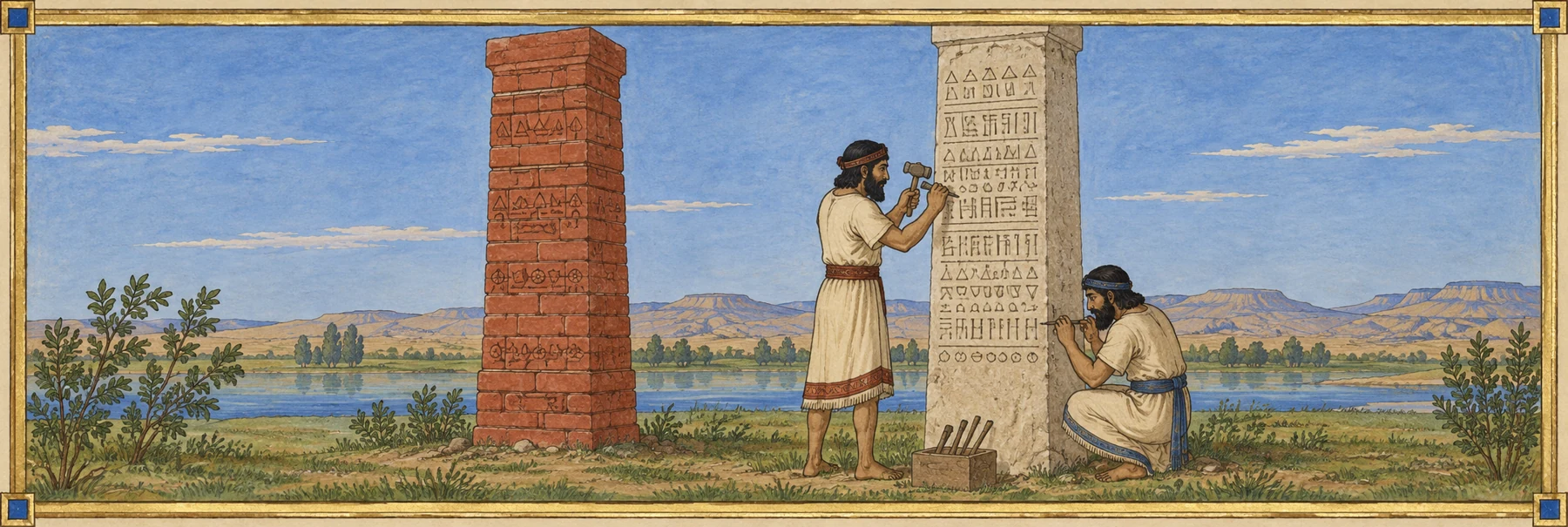
So Seth's children made two pillars, one of brick and one of stone, and on both of them they carved everything they had discovered. If water came and washed away the brick one, the stone one would still be standing, and whoever came after could read it.
They were building for readers they would never meet, on the far side of a disaster they had never seen.
Chapter Four
Nine Hundred Years
The shining child
Methuselah's son Lamech married a woman named Betenos, and she had a baby.
When the baby was born, the midwife nearly dropped him.
He was white. White as snow, and red as a rose, both at once, and the hair on his little head was as white as wool. And when he opened his eyes, the whole house filled with light, as if the sun had come up inside it. And then the baby, who was not an hour old, sat up in the midwife's hands, and opened his mouth, and spoke to the Lord.
Lamech took one look at him and ran out of the house.
He ran all the way to his father Methuselah, and burst in on him, white-faced. "I have a son," he said, "and he isn't like a man. He's like one of the angels. His eyes are like the rays of the sun. I don't think he's mine at all. I think he's theirs."
Chapter Four
Nine Hundred Years
The shining child
He meant the Watchers. By then they had begun to go wrong, and had taken wives among the daughters of men, and everyone knew what kind of children came of it.
"I'm afraid something terrible is going to happen on the earth in his days," Lamech said. "Father, please. Go to Enoch. He lives among the angels now. He'll know."
So Methuselah went.
He went a very long way, further than anyone had ever gone, right to the ends of the earth. And when he could go no further, he stood there at the edge of everything and cried out his father's name.
And Enoch heard him, and came.
"Here I am, my son," he said. "Why have you come all this way?"
Methuselah told him everything: the white baby, the light in the house, the frightened father. And Enoch listened, and then told him what he knew.
Chapter Four
Nine Hundred Years
The shining child
"In the days of my father Jared," he said, "some of the angels of heaven broke the word of the Lord. They have gone in to the daughters of men and taken wives and had children by them. A great destruction is coming over the whole earth. There will be a flood, and a destruction that lasts a year.
"But this child of Lamech's will be left. He and his three sons will be saved, when everything else on the earth dies.
"Go back and tell Lamech that the boy truly is his son. Tell him it is no lie. And tell him to call him Noah, because he will be left to you, and after all the destruction he will bring the earth comfort."
So Methuselah went home and told Lamech everything, and they called the child Noah.
And Lamech held his strange shining son and said: "This one will give us comfort. Comfort from our work, and the toil of our hands, and the ground the LORD has cursed."
Chapter Four
Nine Hundred Years
The shining child
Noah sounds like rest. More than a thousand years they had been pulling up thorns, and Lamech was tired, and he hoped with all his heart that this boy would bring them rest at last.
He did not yet know what kind of rest it would be.